Table of Contents(6 sections)
Evidence status: researched
This guide synthesizes verified manufacturer specifications, technical data sheets, and professional detailing workflows. DetailRig has not performed a single controlled laboratory test across all products discussed here; specific performance claims are attributed to their respective manufacturers.
Understanding Orbit Throw Mechanics and Stroke Length
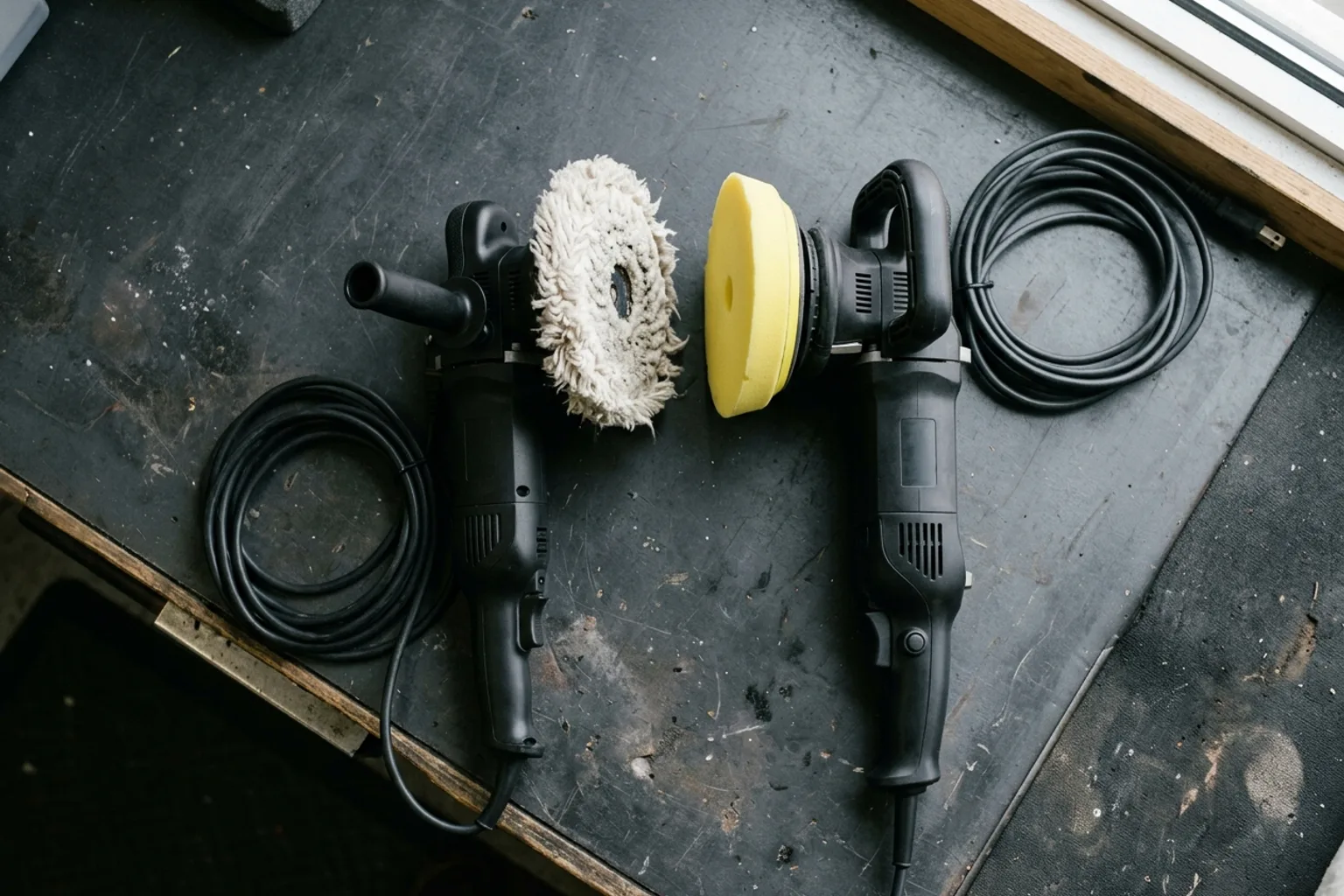
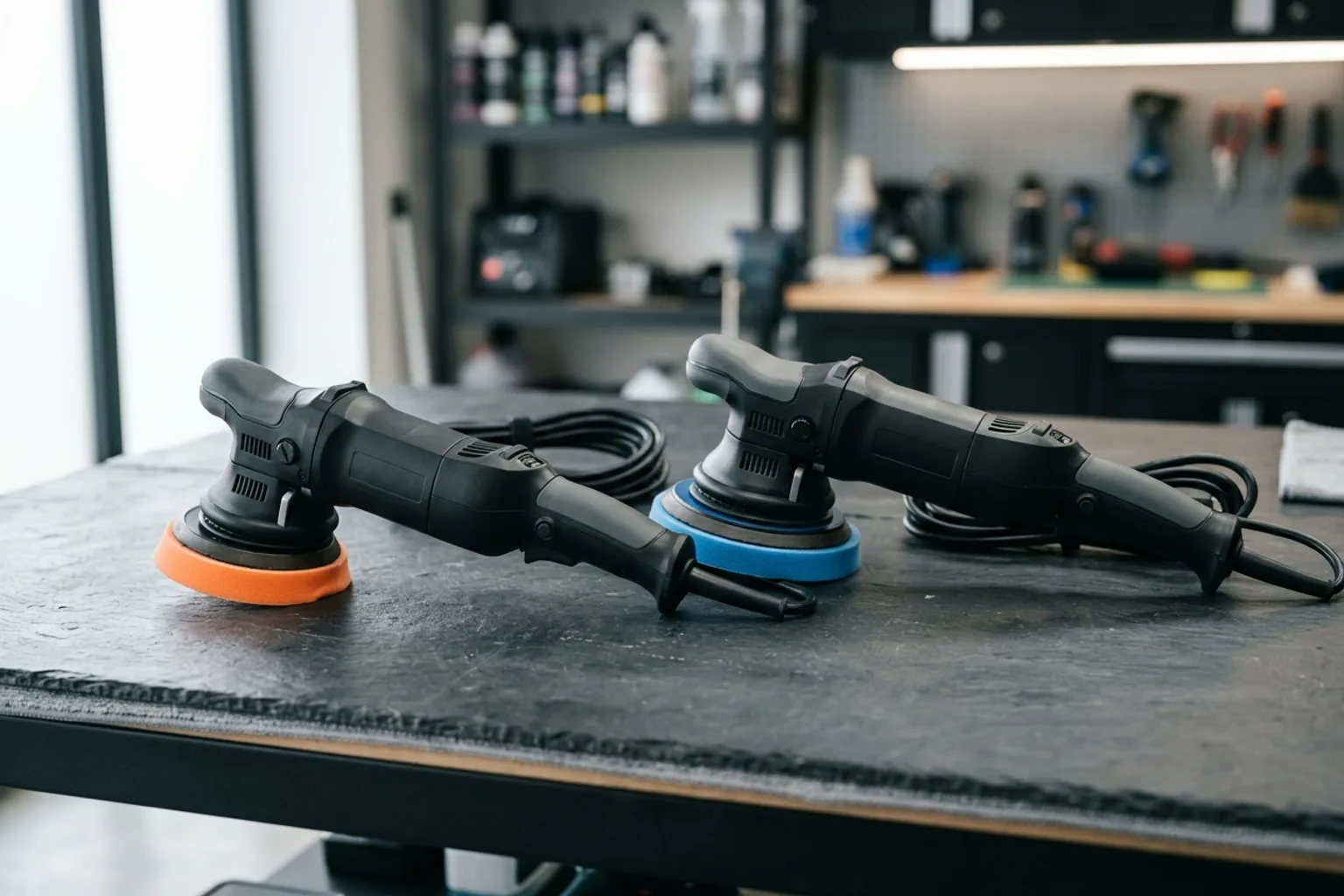
Dual-action (DA) random orbital polishers do not spin in a static circle. Instead, the central spindle orbits around a fixed eccentric counterweight while the backing plate spins freely. The diameter of that elliptical oscillation is the "throw" or stroke length. Traditional DA polishers like the classic Porter Cable utilized a tight 8mm throw. Modern long-throw machines expanded that stroke to 15mm and 21mm, transforming paint correction efficiency.
A 21mm orbit travels significantly farther across the clear coat on each rotation than a 15mm orbit. When swinging a 6-inch (150mm) pad, the outer edge moves across a wide path, covering approximately 40% more surface area per minute. This increases friction and defect leveling speed on expansive, flat sheet metal.
| Feature / Attribute | 15mm Dual-Action Polisher | 21mm Long-Throw Polisher | Performance Difference |
|---|---|---|---|
| Standard Backing Plate | 5 inch (125mm) | 6 inch (150mm) | 15mm uses smaller, more agile pads |
| Flat Panel Cutting Speed | Fast (standard benchmark) | Very Fast (~30-40% faster on hoods/roofs) | 21mm wins on open expanses |
| Contour & Edge Rotation | Maintains rotation on curves | Stalls easily on concave body lines | 15mm maintains steady cut |
| Vibration & User Fatigue | Lower lateral momentum, smoother | Higher centrifugal throw vibration | 15mm is noticeably easier on forearms |
| Tight Space Clearance | Good for A-pillars and doors | Awkward near mirror caps and bumpers | 15mm fits tighter spaces |
| Finishing Polish Clarity | Micro-marring free on soft clears | Can induce micro-tick hazing on soft paint | 15mm finishes cleaner |
The Pad Stall Phenomenon on Modern Sculpted Vehicles
Free-spinning dual action polishers rely on centrifugal momentum to rotate the pad. When a pad encounters uneven surface resistance—such as a convex body swage line, a concave door scallop, or a rear bumper flare—friction drags down pad rotation. If rotation stops and the machine only jiggles back and forth (pad stall), cutting action drops to virtually zero.
Because a 21mm polisher uses a larger 6-inch backing plate and has a massive 21mm elliptical swing, its outer edge frequently makes uneven contact on curved body panels. This concentrated edge drag causes frequent pad stalling unless the operator keeps the machine oriented at an exact, unnatural perpendicular angle. A 15mm machine fitted with a 5-inch pad glides across sculpted compound curves with far less pad stalling.
When to Choose a 21mm Polisher
- You primarily detail large trucks, full-size SUVs, commercial vans, or boats with wide, slab-sided panels.
- You already own a compact 3-inch or 1-inch polisher for bumpers, pillars, and door handle areas, using the 21mm purely as a heavy-hitting primary tool.
- Your goal is maximum production speed across large, flat hood and roof sections during multi-stage paint correction.
When to Choose a 15mm Polisher
- You want a versatile, single-machine setup capable of detailing an entire car from front bumper to rear diffuser.
- You work on modern sedans, sports cars, and compact crossovers with intricate body lines and aggressive creases.
- You polish softer, sensitive Japanese or vintage clear coats where a 21mm throw can create micro-tick haze during fine jewel polishing.
- You prefer a balanced, low-vibration tool that minimizes operator joint fatigue during full-day corrections.
Practical Setup Advice for Machine Polishers
Backing plate modification advisory
Many operators try fitting a 5-inch backing plate onto a 21mm machine to improve clearance. While physically possible, this changes the counterweight balance and substantially increases lateral tool vibration. Buy the machine engineered for your intended backing plate size rather than altering counterweight geometry.
Straight answers
Frequently Asked Questions
Answers based on the evidence and sources identified in this article.
Can I use a 21mm polisher as my only machine?
It is challenging. While exceptional on hoods and roofs, a 21mm machine with a 6-inch pad is too unwieldy for mirror caps, door pillars, trunk lids, and bumper contours. A 15mm machine is far more practical as an only tool.
Does a 21mm polisher remove scratches faster than a 15mm?
On flat panels, yes, by approximately 30% to 40% due to larger pad swept area. On contoured panels with curves and edges, a 15mm often corrects faster overall because it does not suffer from frequent pad stalling.
Is a 15mm polisher safer for beginners than a 21mm?
Yes. The 15mm produces less lateral vibration, is easier to balance flat against the paint surface, and exhibits gentler rotational edge forces, making it less intimidating for newcomers.
Where to buy
Recommended Gear in this Guide
DetailRig is reader-supported. Recommendations follow each page's evidence label (tested, used, or researched), and we never accept paid placement. When you buy through our links, we may earn an affiliate commission at no extra cost to you.
References & Sources

DetailRig Editorial
ContributorResearch publication
DetailRig Editorial publishes source-linked car-care explainers. These articles synthesize manufacturer instructions and clearly separate research from documented hands-on testing.