Table of Contents(5 sections)
Evidence status: researched
This guide synthesizes verified manufacturer specifications, technical data sheets, and professional detailing workflows. DetailRig has not performed a single controlled laboratory test across all products discussed here; specific performance claims are attributed to their respective manufacturers.
Core Mechanical Differences: Fixed Direct Drive vs Orbital Oscillation
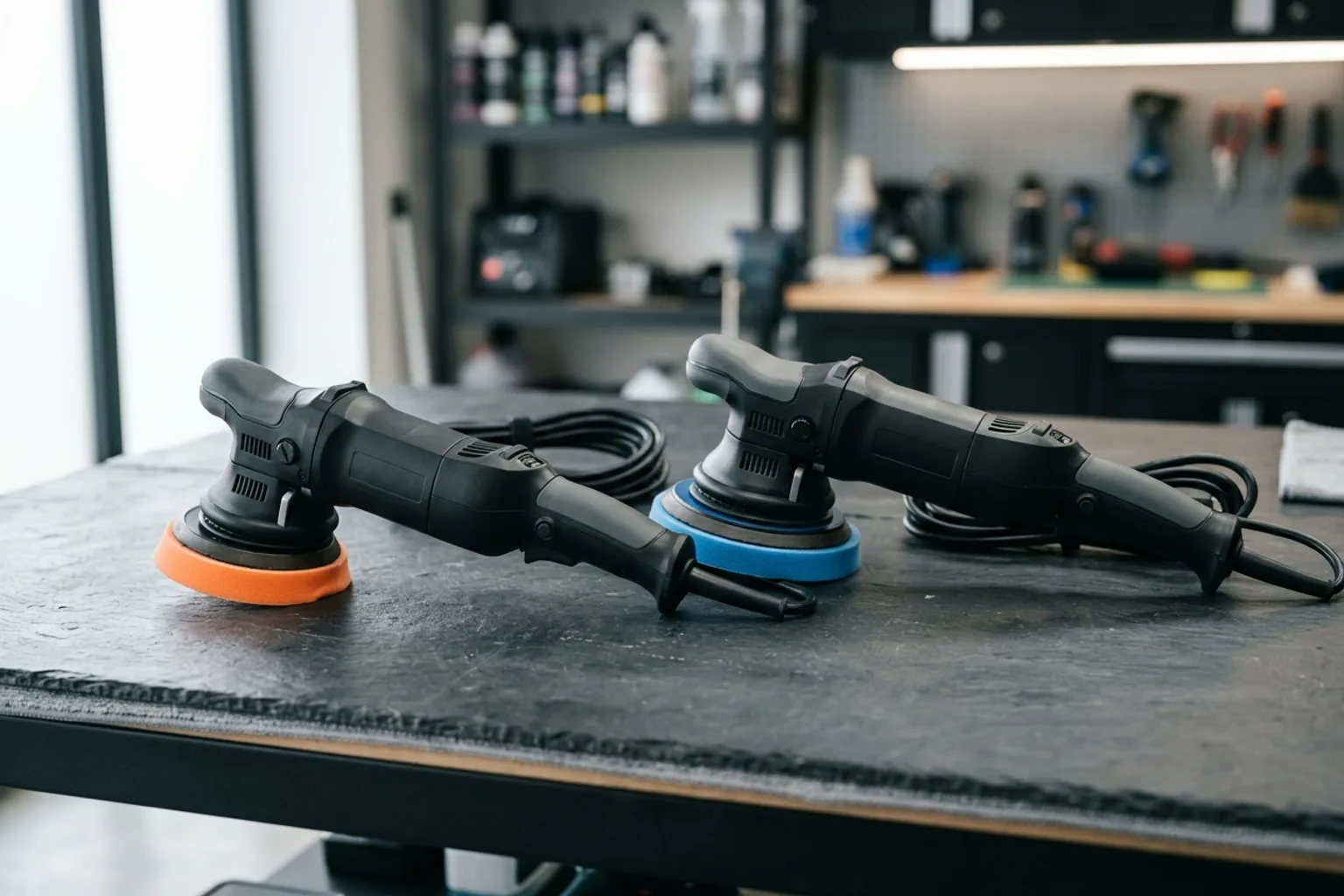
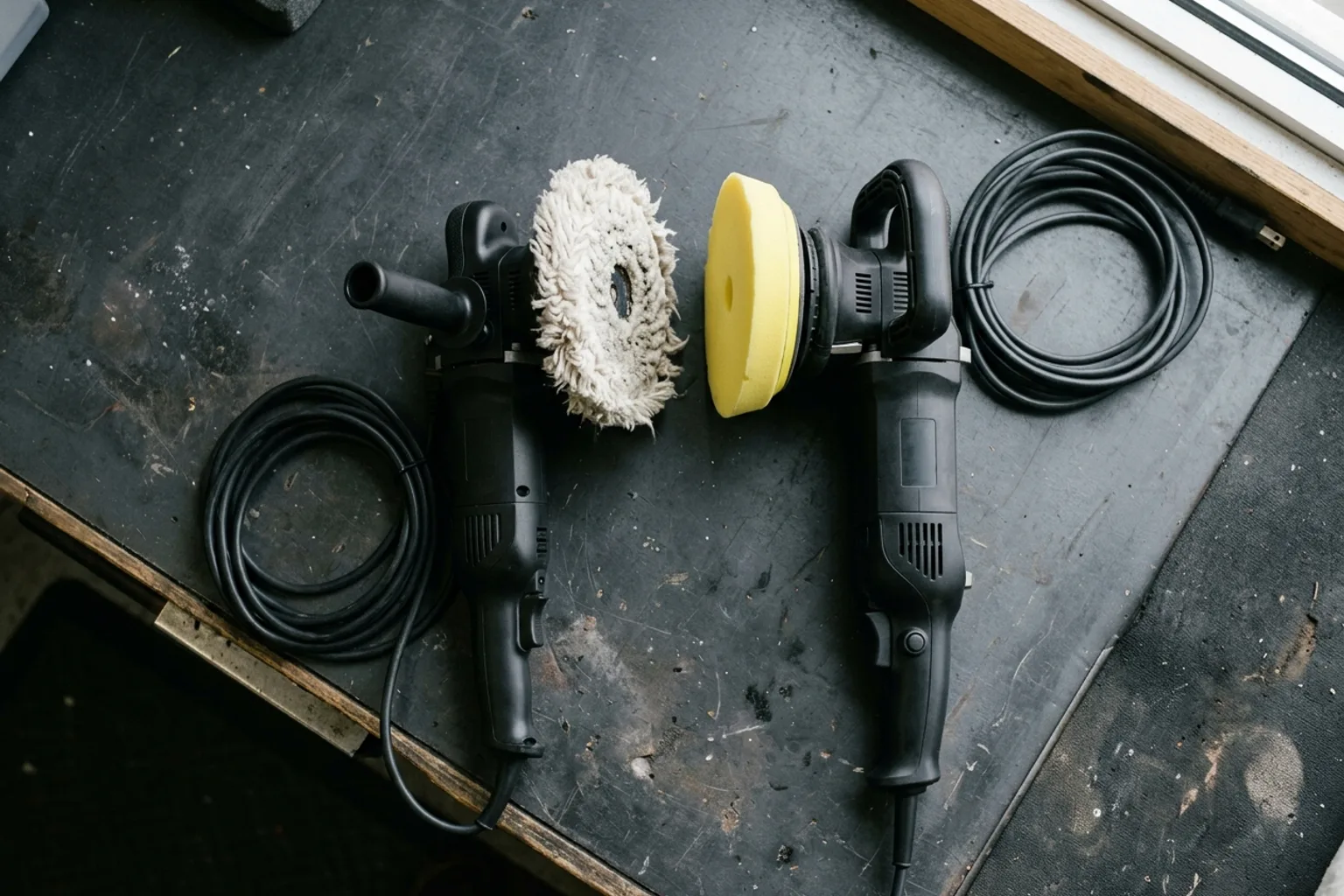
The fundamental difference between a rotary machine and a dual-action (DA) polisher lies in how drive power reaches the backing plate. A rotary polisher (circular buffer) is a direct-drive tool: the motor drives the spindle on a single fixed axis. Whatever speed you select—typically 800 to 2,000 RPM—the pad turns forcefully without stopping, regardless of downward pressure or panel angle.
A dual-action random orbital polisher utilizes a counterbalanced eccentric mechanism. As the central spindle spins, the backing plate is thrown into an orbital loop while rotating freely on a secondary bearing. This dual motion produces a random oscillating pattern that spreads friction across an elliptical path rather than concentrating heat on a single circular contact zone.
| Characteristic | Rotary Buffer (Direct Drive) | Dual-Action Random Orbital | Practical Detailing Impact |
|---|---|---|---|
| Drive Motion | Pure 1:1 circular rotation | Orbital oscillation + free rotation | Rotary has relentless mechanical torque |
| Heat Generation | Rapid, high localized friction | Gentle, dispersed friction heat | Rotary can heat clear coat past safe glass transition temp |
| Risk of Paint Burn-Through | High (especially on thin edges and plastic bumpers) | Extremely low (pad stalls under excess force) | DA protects sensitive edges and sharp swage lines |
| Hologram / Buffer Trail Risk | Very high if finished with rotary | Virtually zero when paired with finishing foam | DA finishes clean without optical trails |
| Heavy Defect Removal Speed | Maximum (levels 1,500 grit sanding marks instantly) | High with microfiber pads and modern abrasives | Rotary maintains edge on severe damage |
| Learning Curve | Steep (requires extensive muscle memory and technique) | Low to moderate (safe for beginners in hours) | DA allows safe DIY operation |
The Hologram Hazard: What Causes Buffer Trails?
When a rotary polisher spins a pad across clear coat, the abrasive particles trace identical circular concentric microscopic grooves. In shade, the finish may appear glossy, but under direct sunlight or inspection LEDs, those circular grooves reflect light in sweeping, three-dimensional ghosted ribbons known as holograms or "buffer trails."
Eliminating holograms with a rotary requires extraordinary technique, soft jeweling pads, and diminishing finishing polishes. Even skilled professionals often switch to a dual-action polisher for final finishing. Because a DA polisher continually changes abrasive direction through orbital oscillation, it cannot create concentric circular tracks, leaving a perfectly crisp, reflection-clear finish.
Clear Coat Heat Buildup and Edge Safety
Automotive clear coats are thermoset acrylic polyurethane layers roughly 35 to 50 microns thick—thinner than a Post-it note. As surface temperature exceeds 140°F (60°C), clear coat softens. Past 180°F (82°C), paint can delaminate or burn away completely, particularly along sharp panel ridges and plastic bumpers where heat cannot dissipate through metal.
A rotary polisher can generate dangerous 160°F+ temperatures within 15 seconds if held in one spot or tilted onto its edge. In contrast, a dual-action polisher continually moves the contact footprint and stalls its rotation if tilted unevenly, preventing catastrophic heat buildup.
Which Polisher Should You Invest in Today?
- Choose a Dual-Action Polisher if: You want a reliable, safe tool for personal vehicles, weekend detailing, or general enhancement that eliminates swirls and scratches without risking burn-through.
- Choose a Rotary Polisher if: You operate a high-volume body shop leveling fresh wet-sanded paint, restoring gelcoat on fiberglass boats, or requiring raw mechanical torque for industrial defect leveling.
Straight answers
Frequently Asked Questions
Answers based on the evidence and sources identified in this article.
Can a beginner safely use a rotary polisher?
It is not recommended. Rotary buffers generate rapid friction and will burn clear coat off high-spot ridges or melt plastic bumper paint within seconds if tilted incorrectly. Beginners should always learn on a dual-action machine.
Can modern DA polishers replace rotary buffers entirely?
For 95% of automotive detailing, yes. Modern long-throw DA polishers combined with microfiber cutting pads and engineered diminishing abrasives level clear coat nearly as quickly as rotary buffers without leaving holograms.
Why do boat detailers still prefer rotary polishers?
Marine gelcoat is roughly ten times thicker and substantially harder than automotive clear coat. Leveling oxidized gelcoat requires the unrelenting heat and continuous torque of a rotary machine.
Where to buy
Recommended Gear in this Guide
DetailRig is reader-supported. Recommendations follow each page's evidence label (tested, used, or researched), and we never accept paid placement. When you buy through our links, we may earn an affiliate commission at no extra cost to you.
References & Sources

DetailRig Editorial
ContributorResearch publication
DetailRig Editorial publishes source-linked car-care explainers. These articles synthesize manufacturer instructions and clearly separate research from documented hands-on testing.