Table of Contents(6 sections)
What the Numbers Describe
The ratios describe the stated polyester-to-polyamide blend. The Rag Company's comparison chart gives 70/30 a softer, more absorbent positioning and 80/20 a tougher, lower-cost positioning. That can help narrow a manufacturer range, but it is not a universal quality hierarchy or a complete prediction of how two specific towels behave.
Evidence status: researched
The blend descriptions are attributed to the cited manufacturer. DetailRig has not independently measured softness, absorbency, durability, or scratch risk for these ratios.
| Specification | What it can help compare | What it cannot establish alone |
|---|---|---|
| 70/30 blend | Manufacturer-positioned softness and absorbency within suitable products | Guaranteed superiority on every surface or weave |
| 80/20 blend | Manufacturer-positioned toughness and value within suitable products | That every towel is harsh or only fit for dirty work |
| GSM | Fabric weight per square metre | Absorbency, pile behavior, or finish safety by itself |
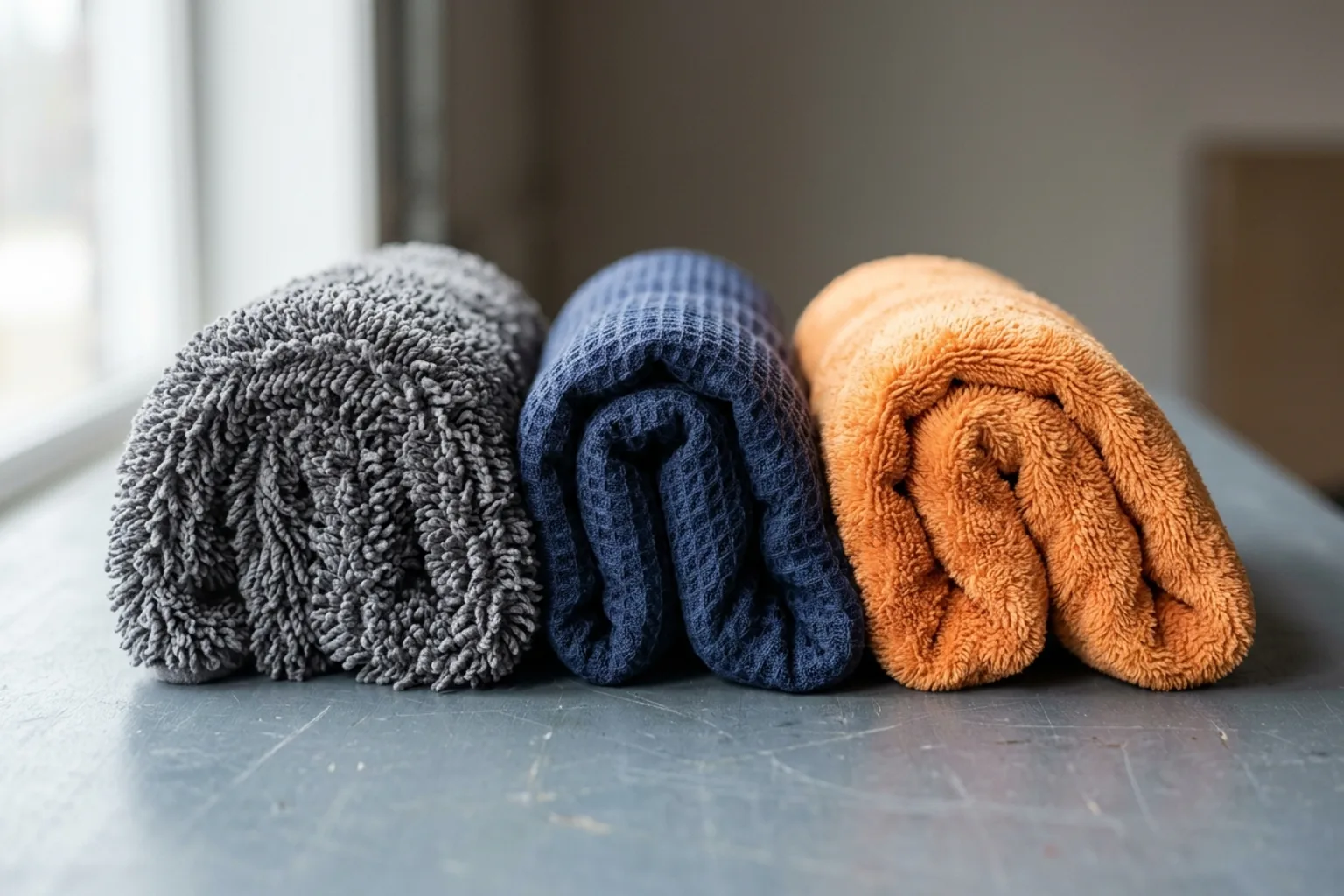
| Weave and size | Handling and intended task such as drying or buffing | Cleanliness or freedom from defects |
| Edge and condition | Border construction and current serviceability | A scratch-free guarantee |
When 70/30 May Be Worth Considering
Consider a 70/30 towel when the exact product's weave, size, edge, and intended use fit your task and you prefer the manufacturer's softness or absorbency positioning. A paint or drying towel still needs its own clean laundry group and inspection. The ratio does not make a utility towel appropriate for finishing work.
When 80/20 Can Be a Rational Choice
Consider 80/20 when the specific towel is designed for your job and its cost and durability positioning fit the way you maintain tools. It is not automatically a reject for every automotive surface. Read the product's actual use description instead of inventing a rule that one blend is always safe and the other always harmful.
- For drying: compare towel dimensions, weave, water load, edge, and handling.
- For buffing: compare product-removal suitability, pile, surface, and residue rather than blend alone.
- For interiors: choose a construction intended for the material and soil level.
- For wheels and dirty jobs: keep tools separate rather than downgrading a paint towel without a clear system.
A Better Five-Point Buying Check
Compare two microfiber towels
5 stepsName the task
Decide whether the towel is for drying, buffing, glass, interior, or utility cleaning.
Compare the construction
Read blend, weave, GSM, dimensions, and edge together rather than ranking one number in isolation.
Check intended use
Use the manufacturer's surface and task designation, especially for paint and delicate finishes.
Plan laundering and storage
Follow care directions and maintain clean task-specific groups. Performance can decline when towels are contaminated or incorrectly laundered.
Buy a manageable quantity
Choose enough clean towels for the job and handling preference without assuming a larger or higher-spec towel removes the need for good technique.
Reasons Not to Upgrade
Skip a blend upgrade if the real issue is a dropped towel, fabric-softener residue, an awkward size, a dirty surface, or excessive pressure. A different ratio cannot solve those process failures. Buy when the complete towel better fits the defined task, not because 70/30 sounds like a premium badge.
Straight answers
Frequently Asked Questions
Answers based on the evidence and sources identified in this article.
Is 70/30 always better than 80/20 microfiber?
No. The cited manufacturer gives them different positioning, but weave, GSM, size, edge, condition, and task determine the useful choice.
Does 80/20 microfiber scratch paint?
The blend alone does not prove that a specific towel will scratch. Use a product intended for paint, keep it clean and undamaged, and control surface contamination and pressure.
Is higher GSM more important than blend?
Neither number should be viewed alone. GSM is fabric weight, not a direct absorbency or safety score; compare the complete towel for the intended job.
Where to buy
Recommended Gear in this Guide
Active 2.0 1800 PSI 2.0 GPM Pressure Washer
Our lab-tested standard for safe automotive flow and pressure.
DetailRig is reader-supported. Recommendations follow each page's evidence label (tested, used, or researched), and we never accept paid placement. When you buy through our links, we may earn an affiliate commission at no extra cost to you.
References & Sources

DetailRig Editorial
ContributorResearch publication
DetailRig Editorial publishes source-linked car-care explainers. These articles synthesize manufacturer instructions and clearly separate research from documented hands-on testing.